Leaves & growth habit
Photograph the whole plant and a close view of the leaves. Record leaf shape, arrangement, hairs and whether the plant forms a rosette, upright stems or creeping runners.
 TURF IDENTIFICATION & CONTROLOriginal guides ↗
INDIGO SPECIALTY PRODUCTS / FIELD REFERENCE
Explore grass, sedge and broadleaf weed photographs, narrow your shortlist and check the features in the field.
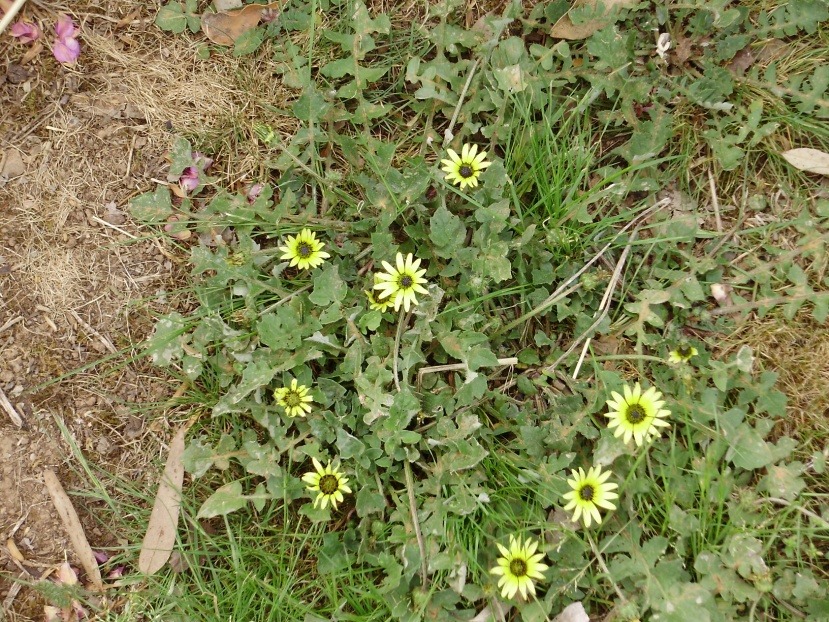 CAPEWEED / ARCTOTHECA CALENDULA
01 / PHOTO REFERENCE
Use the images to build a shortlist.
Photographs alone cannot confirm an identification.
02 / WEED CONTROL
Control options from the supplied Indigo charts.
Check the current label before application.
Rates are chart product ranges, not weed-specific application directions. Confirm turf tolerance, weed stage, permitted use situation and all directions on the current label. Broadleaf application timing is not specified in the chart.
03 / FIELD CHECKS
General field observations to support identification.
Confirm identity before choosing a treatment.
Photograph the whole plant and a close view of the leaves. Record leaf shape, arrangement, hairs and whether the plant forms a rosette, upright stems or creeping runners.
Capture flowers or seedheads where present, with a scale reference. Look at their shape and position, and record the date and location. A young or recently mown plant may lack these features.
Check the leaf, stem, base and seedhead together. Photograph the collar area where the blade meets the sheath. This guide includes sedges and Onion Grass alongside grass references; its type filter helps organise the photographs.
Record the turf species, affected area, moisture, soil conditions and recent maintenance. Some grasses listed here are desirable turf in other situations; whether a plant is a weed depends on the site and intended turf.
Select up to three cards to compare the source photographs. Check several features rather than relying on colour or a single leaf. If the plant does not match well, collect more photographs or seek specialist identification.
Use the weed-control section to find products marked in the supplied charts. Confirm the weed, turf species and use situation, then consult the relevant current product label for the correct rate and application directions.
04 / SOURCES & FIELD NOTES
Each photo’s Explore details view includes subject-specific biology or cause, distinguishing features and Australian seasonal monitoring guidance, reviewed 19 October 2026. Expand its references for the supporting botanical, entomological and turf research sources. Seasonal interpretations allow for regional climate, turf host and site history.
Supplied chart: 38 weed categories and six products. The Creeping Indigo / Contra M entry carries an asterisk: the chart states that a permit applies in some regions. Confirm the permit, jurisdiction and conditions before use.
Supplied chart: 21 weed categories and 11 products, including pre- and post-emergent timing. Duke 100WG / Wintergrass is marked with #, but the workbook provides no explanation; verify the conditions before use.
Updated grass chart supplied 12 October 2026. Recondo 100WG now lists trifloxysulfuron sodium, 75–300 g/ha and 0.75–3 g/100 m². Recondo rates throughout this guide are displayed in g/ha (grams per hectare), with the corresponding small-area rates in g/100 m², as requested by Indigo on 26 October 2026; Battalia 435’s displayed rate was confirmed by Indigo as 2.3–3.4 L/ha on 25 October 2026; the downloadable source chart is retained as supplied. Check the notes in the relevant product entries.
The supplied workbook provides 18 labelled photographs covering grasses, sedges and a grass-like plant. Common names are reproduced from its captions; this workbook does not provide scientific names. Botanical names for 16 grass and grass-like references were supplied by Indigo on 26 October 2026 and appear on the cards and detail views; the original workbook captions remain unchanged.
Download original grass guide ↗The supplied workbook provides 27 labelled broadleaf weed photographs and their scientific-name captions. Caption spellings are retained as supplied; line breaks and repeated spaces are normalised for readability.
Download original broadleaf guide ↗Photographs use the images above the source captions, except Bahiagrass, Bindii, Mallow, Chickweed, Creeping Cinderella, Creeping Indigo, Creeping Oxalis, Cudweed, Khaki Weed, Medics, Mexican Clover, Summergrass, Wintergrass and Shepherd’s Purse, updated with supplied photographs on 25 October 2026. Red Flowered Mallow, Salvation Jane / Paterson’s Curse, Soursob, White Root, Green Amaranth and Cobbler’s Peg are additional supplied photographs dated 25 October 2026. Subterranean Clover is an additional photograph supplied on 26 October 2026, with Chikara listed as its control option by Indigo. Chikara control of Salvation Jane / Paterson’s Curse and Soursob was supplied by Indigo on the same date; this is an addition to the original control charts. Decorative artwork and logos are excluded from the photo count. Detail views identify the source workbook and caption cell where applicable, and credit supplied replacement or additional photographs.
The photographs support comparison rather than a confirmed identification. The field checks are general observation prompts, separate from the workbook captions.
Continue exploring the Indigo identification series.
Disease Identification Guide →
The weed-control section reproduces marked entries and product rate ranges from the supplied control charts. Blank cells indicate no marked entry in these sources, rather than proof that a product has no activity.